Dota 2 is a multiplayer online battle arena (MOBA) video game developed and published by Valve. The game is a sequel to Defense of the Ancients (DotA), which was a community-created mod for Blizzard Entertainment‘s Warcraft III: Reign of Chaos. Dota 2 is played in matches between two teams of five players, with each team occupying and defending their own separate base on the map. Each of the ten players independently controls a powerful character, known as a “hero”, who all have unique abilities and differing styles of play. During a match players collect experience points and items for their heroes to successfully defeat the opposing team’s heroes in player versus player combat. A team wins by being the first to destroy the other team’s “Ancient”, a large structure located within their base.Dota 2
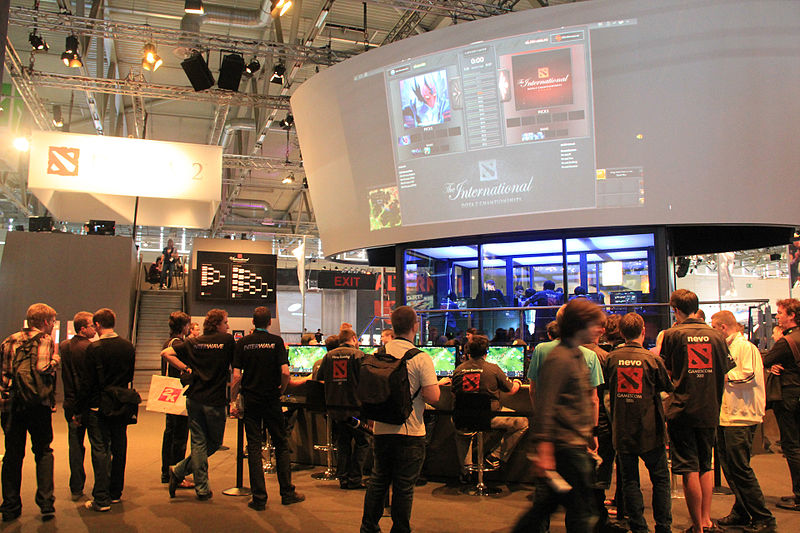
Dota 2 was first made available to the public at Gamescom in 2011, coinciding with the inaugural International championship, the game’s premier esport tournament event. At the event, Valve began sending out closed beta invitations to DotA players and attendees for the Microsoft Windows version of the game.[102] Although the game was originally meant to publicly release in 2012, Valve later scrapped that plan as it would have kept the game in its closed beta state for over a year. Owing to that, Valve lifted the non-disclosure agreement and transitioned the game into open beta in September 2011, allowing players to discuss the game and their experiences publicly.[103][104]
Following nearly two years of beta testing, Dota 2 was officially released on Steam for Windows on July 9,
In 2013, and for OS X and Linux on July 18, 2013.[105][106][107] The game did not launch with every hero from Defense of the Ancients. Instead, the missing ones were added in various post-release updates, with the final one, as well as the first Dota 2 original hero, being added in 2016.[108][109] Two months following the game’s release, Newell claimed that updates to Dota 2 generated up to three percent of global internet traffic.[110] In December 2013, the final restrictions against unlimited global access to Dota 2 were lifted after the game’s infrastructure and servers were substantially bolstered.[111] In order to abide by the standards set by the economic legislation of specific countries, Valve opted to contract with nationally based developers for publishing. In October 2012, Chinese game publisher Perfect World announced they had received distribution rights for the game in the country.[112] The Chinese client also has a region-specific “Low Violence” mode, which censors and changes most depictions of blood, gore, and skulls in order for the game to follow censorship policies of the country.[113][114] In November 2012, a similar publishing deal was made with the South Korea-based game company Nexon to distribute and market the game in the country, as well as in Japan.[115] Three years later, Nexon announced they would no longer be operating servers for Dota 2, with Valve taking over direct distribution and marketing of the game in those regions.[116]
To ensure that enough Defense of the Ancients players would take up Dota 2 and to promote the game to a new audience, Valve invited sixteen accomplished Defense of the Ancients esports teams to compete at a Dota 2-specific tournament at Gamescom in August 2011, which later became an annually held event known as The International.[127] From The International 2013 onward, its prize pool began to be crowdfunded through a type of in-game battle pass called the “Compendium”, which raises money from players buying them and connected lootboxes to get exclusive in-game cosmetics and other bonuses offered through them.[128][129] 25% of all the revenue made from Compendiums go directly to the prize pool, with sales from the 2013 battle pass raising over US$2.8 million, which made it the largest prize pool in esports history at the time.[130][131] Each iteration of The International since then has surpassed the previous one’s prize pool, with the most recent one, The International 10, having one at over $40 million.[132][133]
During its beta phase in the early 2010s, several other esport events would begin hosting Dota 2 events, including the Electronic Sports World Cup,[134] DreamHack,[135] World Cyber Games,[136] and ESL.[137] By the end of 2011, Dota 2 was already one of the highest-paying esport games, second only to StarCraft II.[138] At E3 2013, South Korean company Nexon announced the investment of ₩2 billion (approximately US$1.7 million) into local leagues in the country, which coincided with their distribution partnership with Valve for the game.[139] In February 2015, Valve sponsored Dota 2 Asia Championships was held in Shanghai with a prize pool of over $3 million, raised through compendium sales.[140][141] Since then, other Dota 2 Asia Championships have taken place, with it being sometimes being referred to as the “Chinese International”.[142][143] In total, professional Dota 2 tournaments had earned teams and players over $100 million by June 2017, with over half of that being awarded at Internationals, making it the highest earning esport game by a margin of nearly $60 million at the time.[144]
.jpg)
.jpg)
As with traditional sporting events, most major Dota 2 events feature pre- and post-game discussion by a panel of analysts (left), with in-match casting being done by play-by-play and color commentators (right).
From late 2015 until early 2017, Valve sponsored a series of smaller-scale, seasonally held tournaments known as the Dota Major Championships, which all had fixed prize pools of US$3 million.[145][146] Their format was based on the tournament series of the same name that Valve also sponsored for their first-person shooter game, Counter-Strike: Global Offensive. Including The International 2016 and 2017, which were considered to be the cumulative Major of their respective seasons,[145][147] the series had five other events, which were the Frankfurt Major,[148] Shanghai Major,[149] Manila Major,[150] Boston Major,[151] and Kiev Major.[152] Following the International 2017, the Majors were replaced with the Dota Pro Circuit (DPC) format due to criticism by teams and fans for Valve’s non-transparent and unpredictable nature for handing out International invitations.[153][154][155] In the DPC, teams are awarded qualification points for their performance in sponsored tournaments, with the top twelve earning direct invites to that season’s International.[156] To avoid conflicting dates with other tournaments, Valve directly manages the scheduling of them.[155]
The primary medium for professional Dota 2 coverage is through the video game live streaming platform, Twitch. For most major events, tournament coverage is done by a selection of dedicated esports organizations and personnel who provide on-site commentary, analysis, match predictions, and player interviews surrounding the event in progress, similar to traditional sporting events.[157][158] Live Dota 2 games and coverage have also been simulcast on television networks around the world, such as ESPN in the United States,[159][160] BBC Three in the United Kingdom,[161] Sport1 in Germany,[162] TV 2 Zulu in Denmark,[163] Xinwen Lianbo in China,[164] Astro in Malaysia,[165] and TV5 in the Philippines.[166]
Dota 2
Official logo
Dota 2 is an Action RTS game, developed by Valve Corporation. The title was formally announced on October 13, 2010; and was released as a Free to Play game on July 9th, 2013 for Windows, and July 18th, 2013 for Mac OS and Linux. It is the successor to the very popular Warcraft 3 mod, Defense of the Ancients, which was based on the Aeon of Strife map for StarCraft.null
Basic premise
Dota 2 is an RTS-styled MOBA-type competitive team game with RPG elements. Two competing teams (Radiant and Dire) consist of five players each. The main objective in Dota 2 is to destroy the enemy Ancient inside their stronghold. These strongholds are protected by multiple towers down 3 lanes. Instead of building armies of units like in classical RTS games, each player controls a single Hero, a strategically-powerful unit with unique abilities and characteristics which can be improved over the course of the game. Experience is earned when nearby creeps and heroes die, and once collecting enough experience, the hero gains a level, which increases the hero’s stats, and at most levels the hero gains a skill point which can be spent to unlock or upgrade one of the hero’s abilities. Alongside a hero’s fixed abilities, each hero has 6 inventory slots which can be filled with Items which provide various benefits and abilities. To purchase these items, Gold is gained passively over time, by killing creeps, by killing enemy heroes and by destroying buildings.
Dota 2 has a heavy emphasis on tactics and team co-ordination, and a deep amount of strategy focused on building up strength as fast as possible, optimal itemization, and selecting what order to upgrade your hero’s spells.
Development
IceFrog, the lead developer for the original Defense of the Ancients, was hired by Valve Software in 2009.
The beta began in 2010, officially ending in July 2013 just before The International 2013 when the Windows client was officially released to the public with a queue system to deal with high traffic. The Mac and Linux clients were released a week after the general release of the Windows client. Dota 2 runs on the Source 2 Engine and mimics some of the quirks that were present in the original DotA game in order to preserve gameplay.
Map
Main Article: Map


The Map is the playing field for all Dota 2 matches. It has two sides, one for the Radiant faction, and one for the Dire faction. To win, players must destroy the opposing side’s Ancient, an important building at the center of each team’s base. The map is represented in the interface by the minimap. It is also important to note that the game only contains one map by default, however, custom games can feature new, community created maps.
Heroes
Main Article: Heroes
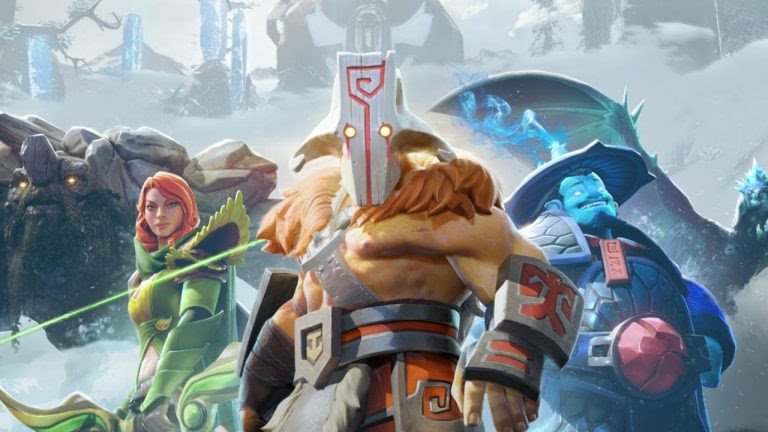
Heroes are each unique characters within Dota 2. At the start of each game, two teams of five are randomly assigned to Radiant and Dire, then sides take turns selecting a Hero from the Hero Pool. Each player controls a single Hero and any units that hero controls, such as summoned units like Eidolons. The selection of these 10 heroes is commonly referred to as that match’s draft.
Heroes will gain experience when enemy units are killed nearby. They start the game at level one, and as they earn experience, they eventually level up, and each level grants more increases to the hero’s attributes and an ability point to spend on upgrading abilities or Talents.
In addition to a hero’s abilities, each hero has a melee or ranged attack which does an amount of damage based on the primary attribute: strength, agility, or intelligence.
Dota 2 has currently implemented 121 heroes. 112 of these heroes were based on heroes from DotA Allstars; and after porting all the DotA heroes, 9 more original heroes have been added.
Items
Main Article: Items
Items are used to give Heroes additional various abilities, attack modifiers, bonus attributes, as well as secondary stats such as armor, attack speed, or improved regeneration of health or mana. Items are sold at Shops, which can be found at the base, the side-lanes, or the more secluded Secret Shops. More powerful items can be constructed by combining weaker items in fixed combinations which require a specific set of items to be in the inventory together. Items take up space in the Hero’s inventory, courier‘s inventory, or stash, all of which have 6 slots for storage and an additional 3 backup space where items are muted and can be switched with the main inventory items with the activation delay of 6 seconds.
Gold and experience
Main Articles: Gold and Experience
Gold is granted periodically, but is largely accumulated by killing hostile units, such as creeps, towers, or enemy Heroes. Depending on what unit you kill, gold may be rewarded solely to the killer (such as creep bounty), or distributed to the killer’s team (such as towers, barracks, couriers and Roshan).
 kuya andre